After the Catch: Why Starship’s Economics Come Down to Turnaround and Permits
11 min read
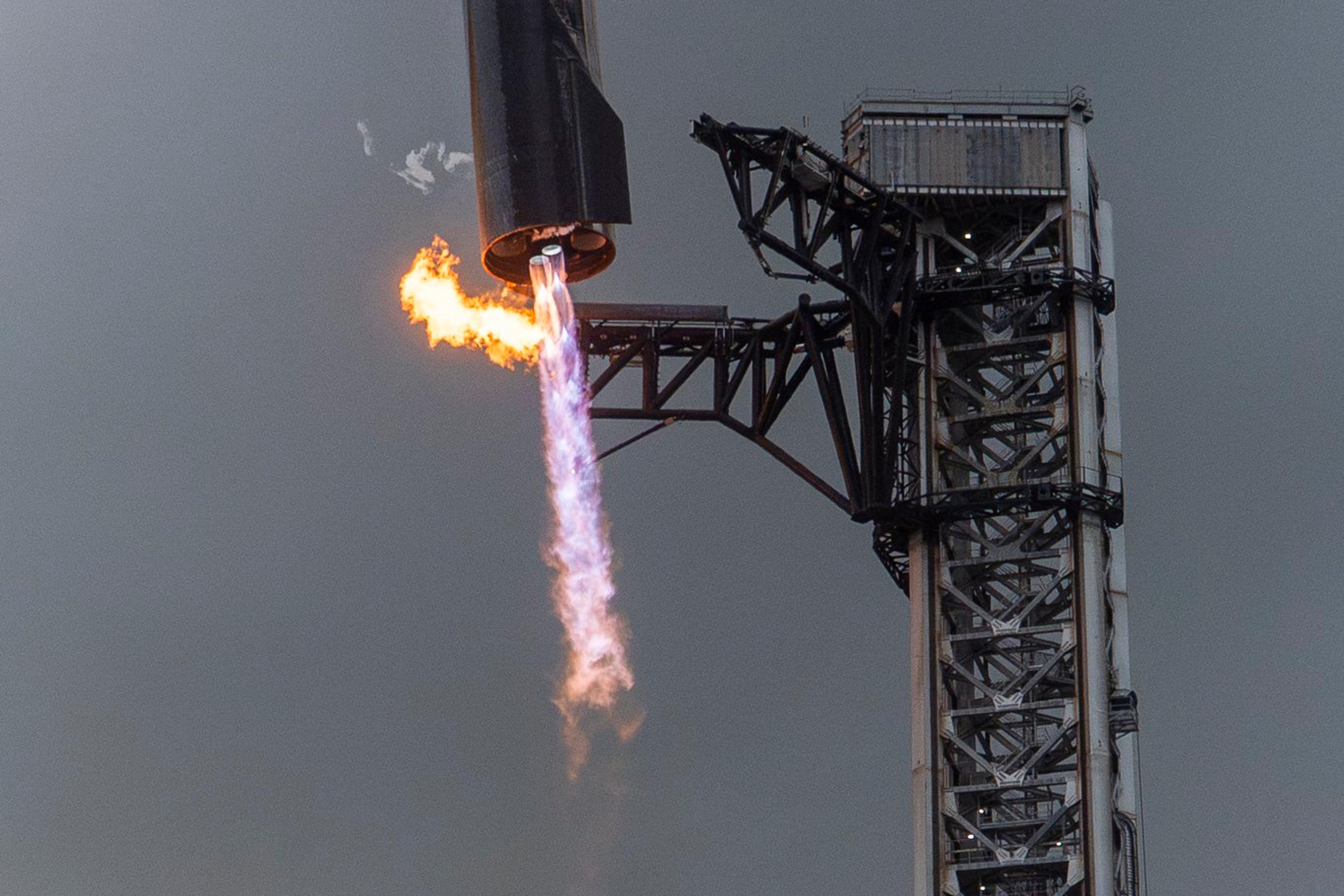
One lesson from Lean operations is that fixing the most visible bottleneck rarely makes a system cheap. It just moves the problem to the next station. That is how I see Saturday’s Starship catch: recovering the upper stage solves one engineering hurdle, but it puts all the pressure on what happens after the vehicle lands.
On November 14, 2026, SpaceX flew Starship Ship 42 back to Starbase in South Texas and caught it with the mechanical arms on Launch Pad 2. The ship had lifted off the evening before, completed 14 orbits, and dropped off 26 Starlink V3 satellites before coming straight back to the tower it left.
Flight 15 was still only half a recovery. All 33 Raptor engines on Booster 22 fired at liftoff, and the problem started right after stage separation. Only 32 engines relit for the boostback burn, and a low fuel mass alarm shut that burn down early. Automated guidance aborted the tower return and sent the booster out over the Gulf of Mexico, where it ran an offshore landing burn and hovered briefly before its flight termination system destroyed it. SpaceX says the root cause is still under investigation. Elon Musk offered a preliminary explanation on X, attributing the shortened burn to "slight underperformance of engines on this flight."
Even with a lost booster, grabbing Ship 42 out of the sky is a very different feat from SpaceX’s earlier booster catches. A booster peels off about two minutes into flight at suborbital speed and heads right back. An upper stage reaches orbital velocity, takes the full brunt of reentry heating over a long return corridor, and still has to park itself between two steel arms. Aside from the Space Shuttle, which brought winged orbiters back to runways for thirty years while discarding its external tank and spending months in maintenance, operational rockets have always thrown their upper stages away. Even Falcon 9, whose boosters now fly as many as 35 times, a record Booster B1067 set in June, still burns up its second stage on every flight.
Weeks in the Hangar
Getting an orbital ship home without wiping out its payload margin took years of redesign. Protecting a 52-meter stainless-steel hull through reentry requires thousands of ceramic tiles, and SpaceX updated the mounting hardware and added curved tiles on Flight 15 to keep hot plasma out of the seams. Heat shields, aerodynamic flaps, and landing fuel add heavy dry mass to Starship V3, so SpaceX leaned on its redesigned Raptor 3 engine to win the weight back. SpaceX says Raptor 3 delivers roughly one metric ton of vehicle-level mass savings per engine once you count supporting hardware and stripped-off shielding, supporting V3’s 100-metric-ton reusable payload target.
Now that a ship has actually made it back, the clock starts on refurbishment. After walking around Ship 42, Musk wrote that it "could probably be reflown with a few weeks of refurbishment."
A few weeks in a hangar makes complete sense for the first caught ship, yet that is one of the problems that broke the Shuttle’s economic promise. Bringing a vehicle home in one piece does not make spaceflight cheap if crews have to check and swap damaged thermal tiles by hand. Ship 42 hung in the tower arms overnight with all six of its Raptor 3 engines intact before SpaceX lowered it into a bay on November 15. Right now, engineers are checking tile wear across the belly and inspecting those six recovered engines. Once Version 3 boosters start coming back too, SpaceX will have 39 engines per full stack to turn around between launches. Nobody outside the company knows yet whether that cycle takes three days or three months.
The Math Behind 456 Launches
Much of the discussion around Starship treats launch economics like a trash-disposal problem. Stop throwing rockets into the ocean, pay mostly for liquid methane and oxygen, and watch orbital pricing drop from $74 million on a dedicated Falcon 9 (roughly $3,250 to $4,230 per kilogram) down toward $100 or $200 per kilogram.
That skips how overhead behaves in any capital-heavy business. Buildings, launch pads, factories, and full-time teams cost roughly the same per year whether you launch 20 times or 200. Reuters reported in May that SpaceX had already put more than $15 billion into Starship. The company also brought in roughly $85.7 billion in gross proceeds from its June IPO, though that capital funds Starlink and xAI as well. Add launch towers in Texas and Florida plus facilities like the Cape Canaveral tile bakery (about 1,000 tiles a day, per SpaceX’s Flight 11 broadcast). Even though SpaceX does not disclose a Starship-only annual operating budget, fixed overhead sits at the center of the economic question.
A rough back-of-the-envelope calculation shows how much flight count moves the numbers. Suppose Starship’s fully allocated fixed costs run $5 billion a year. That is my own illustrative assumption, not a SpaceX disclosure. If every launch carries the full 100-metric-ton (100,000 kg) payload target, dividing $5 billion across the 25 annual launches currently licensed at Starbase comes to $200 million a flight, or $2,000 per kilogram. Spread that same $5 billion across the 456 annual launches SpaceX has asked federal regulators to evaluate for Starbase, and the fixed-cost share falls to about $10.96 million a flight, or roughly $110 per kilogram. That figure covers fixed overhead alone, leaving out fuel, refurbishment, and vehicle wear, and it assumes full cargo bays. If the average flight hauls 50 metric tons instead of 100, those numbers immediately double to $4,000 and $220 per kilogram.
| Vehicle | Reusability | LEO Payload | Price or Assumption | Cost per kg |
|---|---|---|---|---|
| Falcon 9 (2026) | Reusable booster, expendable upper | 17,500 kg (reusable) / 22,800 kg (max) | $74M commercial list price | ~$4,230 / ~$3,250 |
| New Glenn | Reusable booster, expendable upper | 45,000 kg | ~$68M press estimate | ~$1,510 |
| Starship V3 (25/yr) | Full reuse (unproven at cadence) | 100,000 kg (target) | $5B/yr fixed-cost assumption ÷ 25 | $2,000 |
| Starship V3 (456/yr) | Full reuse (unproven at cadence) | 100,000 kg (target) | $5B/yr fixed-cost assumption ÷ 456 | ~$110 |
Note: Commercial list prices (Shattered.io), press estimates (SpaceNexus), and hypothetical fixed-cost allocations are not directly comparable.
A factory and launch network built for hundreds of flights gets very expensive to run when regulators only authorize a few dozen. Today, SpaceX holds an FAA license for up to 25 launches and 50 landings a year at Starbase. In Florida, an FAA environmental review for LC-39A analyzed up to 44 launches and 88 landings per year at Kennedy Space Center (SpaceX still needs an operating license there), while a separate Cape Canaveral review is evaluating up to 76 launches and 152 landings at SLC-37.
The real eye-opener is in Texas. After publishing an October notice of intent for a Programmatic Environmental Impact Statement (PEIS) at Starbase, the FAA moved its November 17 to 19 scoping meetings online and pushed the comment deadline to December 7. Under the two-phase proposal, Starbase would grow to 100 launches and 200 landings per year in Phase 1, then up to 456 launches and 912 landings annually in Phase 2, restricted to weekdays. (Across roughly 260 workdays a year, that comes out to nearly two orbital launches every weekday, which feels surreal to read inside a dry Federal Register notice.) That 456-launch ceiling is an environmental-review proposal, not an approved FAA license. Even so, it is hard to put that request next to SpaceX’s factory buildout and think it is purely about Mars. High cadence is what keeps overhead from undercutting the economics.
Heavy Hardware, Cheap Mass
If SpaceX brings turnaround and launch costs down, the earliest ripple will hit spacecraft engineering budgets long before anyone builds a Mars settlement. Designing and qualifying a complex satellite frequently costs far more than the rocket ride, a pattern NASA Ames systems research links directly to decades of expensive launch mass. When every extra kilogram costs thousands of dollars, teams burn years shaving grams with exotic alloys and fragile folding parts. One jammed hinge can cripple a flagship mission, as NASA learned in 1991 when the Galileo probe’s umbrella-like main antenna refused to open. Cheap mass inside Starship’s wide cargo bay gives engineers room to build heavier, simpler spacecraft using standard industrial parts and extra backups. Aerospace qualification habits change slowly, so that shift will take years, yet cutting upfront design bills could eventually rival the savings on launch itself.
Outside satellite makers are not even the immediate driver. In its Form S-1, SpaceX lays out Starlink V3 satellites targeting 1 terabit per second of downlink capacity and plans to launch up to roughly 60 per Starship mission. Flight 15 released 26, confirming the dispenser works at partial load. Larger batches could lower the capital cost of growing SpaceX’s core broadband network, depending on satellite manufacturing costs and subscriber demand.
NASA is watching closely for a different reason. Under its November 4 lunar plan, Artemis III is targeted for summer 2027 as an Earth-orbit docking test with Blue Origin’s Blue Moon and SpaceX’s Starship V3 lander, followed by a crewed Artemis IV Moon landing targeted for early 2028. SpaceX’s lander still relies on ship-to-ship orbital propellant transfer, an unflown maneuver flagged as a risk factor in the S-1. Because a single lunar trip requires multiple tanker launches, catching Ship 42 was a necessary step toward reusing tankers instead of throwing away a small fleet every time astronauts head to the Moon.
Leaving Town Hall Behind
The wildest pitch attached to SpaceX’s post-IPO valuation is orbital AI compute. After folding xAI and its terrestrial Colossus data centers into the company earlier this year, SpaceX wrote in its S-1: "Our goal over time is to launch 100 gigawatts of compute to space each year." Shedding megawatts of waste heat in a vacuum requires enormous radiator arrays that eat into payload capacity, and AI chips go out of date every few years with no realistic way to swap them in orbit.
What bothers me more than the radiator physics is what happens to local oversight. As I wrote in an earlier post on the environmental cost of data centers, AI buildouts on Earth keep colliding with strained power grids and local water limits. County boards and state utility commissions can be slow and frustrating, yet they give residents actual leverage to push for rate protections or block a zoning change.
Putting compute in low Earth orbit moves much of that infrastructure beyond direct local land-use control. Oversight shifts toward federal launch and satellite licensing, spectrum regulation, and the still-developing rules governing orbital activity. Meanwhile, the physical disruptions do not go away. They pile up around launch sites. After the FAA cleared an additional Starship reentry corridor back to Starbase in September, Ship 42’s overland return rattled the Rio Grande Valley and Cameron County with sonic booms. Separately, regular launch operations at Boca Chica keep closing nearby highways and beaches.
Local influence over those closures has already narrowed. As The Texas Tribune reported, after Starbase incorporated as its own city in 2025, Texas lawmakers shifted weekday authority to close Boca Chica Beach and State Highway 4 for spaceflight operations away from Cameron County to Starbase, while the county kept weekend control. That leaves a municipality closely tied to SpaceX’s workforce overseeing some of the disruptions experienced by surrounding communities, while neighboring residents have limited direct influence over the city’s closure decisions.
In a June Brookings paper, Lauren Tokos argued that the feasibility gap around orbital data centers is itself a governance risk. She pointed out that companies can exploit regulatory gaps unless space communication policy catches up with the market, and urged U.S. policymakers to work with global partners to strengthen space governance and address anticompetitive behavior by major actors. Once one vertically integrated company runs the heaviest rockets, the largest broadband constellation, and orbital compute hardware before comparable rivals exist, regulators will have a hard time rewriting the rules after the fact.
What I Would Tell the FAA Before December 7
Because the FAA’s comment period on the Starbase PEIS runs through December 7, this is live rulemaking. Approving an 18-fold jump from 25 launches a year to 456 before Starship’s economics are proven would lock in local and orbital side effects upfront. If I were filing public comments, I would ask for three conditions in any final permit:
- Gate higher flight caps on turnaround and reliability. Instead of authorizing 456 annual launches on day one, the FAA should tie higher ceilings to verified Version 3 booster catches and public turnaround data. Regulators should evaluate the time and labor required to inspect, repair, and certify recovered vehicles for another flight before opening up higher launch tiers.
- Require independent acoustic monitoring and closure caps. Residents in Cameron County and the Rio Grande Valley should not have to take pre-flight sonic boom models on faith. Expanding overland returns should come with publicly posted, third-party noise monitors and firm annual limits on beach and Highway 4 closure hours.
- Close the FAA-FCC debris reporting gap. Under current U.S. rules, satellite orbital debris sits mostly with the FCC, while FAA environmental reviews focus on launch and reentry. That split got wider in January when the FAA withdrew its 2023 upper-stage orbital debris rulemaking to review its authority and industry costs. Before clearing a 456-launch ceiling, the FAA should require cumulative upper-stage disposal reliability reporting across high-cadence operations and coordinate those reviews directly with the FCC.
The next milestone will probably be less dramatic than the catch itself. What I am watching now is how long Ship 42, or whichever recovered upper stage SpaceX selects next, spends in inspection and refurbishment before it flies again.
Sources29
Primary Filings & Official Sources
Federal Aviation Administration. (2026, January 15). Mitigation methods for launch vehicle upper stages on the creation of orbital debris; withdrawal (Docket No. FAA-2023-1858, 91 FR 1724). Federal Register. https://www.federalregister.gov/d/2026-00680
Federal Aviation Administration. (2026, January 29). Final Environmental Impact Statement for SpaceX Starship-Super Heavy operations at Kennedy Space Center Launch Complex 39A. https://www.faa.gov/space/stakeholder_engagement/spacex_starship_ksc/SpaceX-SSH-LC-39A-Final-EIS-Volume-I.pdf
Federal Aviation Administration. (2026, October 14). Notice of intent to prepare a Programmatic Environmental Impact Statement (PEIS), open public scoping period, and hold public scoping meetings on the proposed SpaceX Starship-Super Heavy launch and landing operations at the Boca Chica launch site at Starbase, Texas (Docket No. FAA-2026-12808, 91 FR 65289). Federal Register. https://www.federalregister.gov/d/2026-20963
Federal Aviation Administration. (2026, November 10). Notice of intent to prepare a Programmatic Environmental Impact Statement (PEIS): Update extending public scoping period and virtual meetings (Docket No. FAA-2026-12808, 91 FR 72611). Federal Register. https://www.federalregister.gov/d/2026-22898
Federal Aviation Administration. (2026). SpaceX Starship Super Heavy project at the Boca Chica launch site. https://www.faa.gov/space/stakeholder_engagement/spacex_starship
Federal Aviation Administration. (2026). SpaceX Starship-Super Heavy at Cape Canaveral Space Force Station. https://www.faa.gov/space/stakeholder_engagement/spacex_starship_ccsfs
Jones, H. W. (2025, July 16). The impact of reduced space launch costs (AIAA 2025-4073). NASA Ames Research Center / AIAA Aviation Forum and ASCEND 2025. https://arc.aiaa.org/doi/pdf/10.2514/6.2025-4073
NASA. (1992). Galileo High Gain Antenna (HGA) failure (1991) (Lesson ID 492). NASA Lessons Learned Information System. https://llis.nasa.gov/lesson/492
NASA. (2026, November 4). NASA shares plans to accelerate Artemis, return to Moon. https://www.nasa.gov/missions/artemis/nasa-shares-plans-to-accelerate-artemis-return-to-moon/
Space Exploration Technologies Corp. (2026, May 20). Form S-1 registration statement. U.S. Securities and Exchange Commission. https://www.sec.gov/Archives/edgar/data/1181412/000162828026036936/spaceexplorationtechnologi.htm
Space Exploration Technologies Corp. (2026, June 15). Space Exploration Technologies Corp. announces closing of initial public offering, including full exercise of underwriters' option to purchase additional shares. SpaceX Investor Relations. https://ir.spacex.com/updates/releases-details/2026/Space-Exploration-Technologies-Corp--Announces-Closing-of-Initial-Public-Offering-Including-Full-Exercise-of-Underwriters-Option-to-Purchase-Additional-Shares-2026-RgoR-Y1Vwh/default.aspx
SpaceX. (2026). Starship. https://www.spacex.com/vehicles/starship
SpaceX. (2026, November 13). Starship catch update. https://www.spacex.com/updates/?u=starship-catch
SpaceX. (2026, November 14). Starship Flight 15. https://www.spacex.com/launches/starship-flight-15
Reporting & Policy Analysis
Ali, I. (2026, November 19). Elon Musk explains the Flight 15 Booster 22 catch abort and FTS triggers. TeslaOracle. https://www.teslaoracle.com/2026/11/19/elon-musk-explains-the-flight-15-booster-22-catch-abort-and-fts-triggers-final-moment-pics-and-video/
Benzinga. (2026, November 16). Elon Musk says SpaceX's recovered Starship could fly again after weeks of refurbishment. https://www.benzinga.com/markets/prediction-markets/26/11/63287055/starship-reuse
Dinner, J. (2026, November 16). Relive Starship's historic Flight 15 with our best photos from launch and Mechazilla tower catch. Space.com. https://www.space.com/space-exploration/launches-spacecraft/relive-starships-historic-flight-15-with-our-best-photos-from-launch-and-mechazilla-tower-catch
Marigny, D. (2026, September 3). FAA clears environmental review for additional Starship return path to Starbase. Port Isabel-South Padre Press. https://www.portisabelsouthpadre.com/2026/09/03/faa-clears-environmental-review-for-additional-starship-return-path-to-starbase/
Nacionale. (2026, November 14). Starship Flight 15 sonic boom return path over Rio Grande Valley and Cameron County. https://www.nacionale.com/en/articles/starship-flight-15-sonic-boom-return-path-rio-grande-valley-cameron-county
Port Isabel-South Padre Press. (2025, June 6). Control of Highway 4 handed to Starbase, sparking public outcry. https://www.portisabelsouthpadre.com/2025/06/06/control-of-highway-4-handed-to-starbase-sparking-public-outcry/
Reuters. (2026, May 1). SpaceX spending on Starship tops $15 billion in rush for airline-like rocketry. https://www.reuters.com/business/autos-transportation/spacex-spending-starship-tops-15-billion-rush-airline-like-rocketry-2026-05-01/
Robinson-Smith, W. (2026, June 7). SpaceX launches Falcon 9 rocket booster on record-breaking 35th flight. Spaceflight Now. https://spaceflightnow.com/2026/06/07/live-coverage-spacex-to-launch-falcon-9-rocket-booster-on-record-breaking-35th-flight/
Shattered.io. (2026). How much does a Falcon 9 launch cost in 2026? https://shattered.io/how-much-does-falcon-9-launch-cost-74-million-list-price-2026/
SpaceNexus. (2026). Space launch cost comparison. https://spacenexus.us/guide/space-launch-cost-comparison
The Orbital Index. (2025, October 15). Issue No. 340. https://orbitalindex.com/archive/2025-10-15-Issue-340/
The Texas Tribune. (2025, July 2). Inside Elon Musk's stellar year at the Texas Capitol. https://www.texastribune.org/2025/07/02/elon-musk-texas-politics-legislature-laws-spacex-tesla/
Tokos, L. (2026, June 25). Orbital data centers' feasibility gap is a governance risk. Brookings Institution. https://www.brookings.edu/articles/orbital-data-centers-feasibility-gap-is-a-governance-risk/
Get new posts by email
One email when something new is published. Unsubscribe any time.
Or follow by RSS